IT security experts will often tell you that employees are the greatest security vulnerability in any company. We warn of social engineering emails and phone calls, reused passwords, work emails used on personal accounts, and dozens of other behaviors that can put your business at risk for breaches and hacks.
According to a cybersecurity report by Kaspersky in 2019, 90% of data breaches occur due to human error. Other sources cite “employee negligence” as a top cause of data breach. Negligence is its own issue, but it’s important to take responsibility as an employer for proper training that could prevent a data breach.
Employee education can save your company millions of dollars. Consider employee education and training the cheapest form of IT security available to companies of any size. Be sure to also take into account the potential costs of data loss—how much would you lose in time and resources in the event of a breach?
Instead of thinking of employees as a liability, consider your team to be a great untapped asset for network security. These five easy behaviors can make a huge difference in your security!
1. Lock your computer when you step away: We may trust our coworkers with our PC, but there are security risks involved when you leave your computer unattended and open. When you walk away from your computer, take a second to press Windows Key + L to lock your screen and protect any sensitive data.
2. Avoid flash drives, especially “found” flash drives: Flash drives are useful, but they can easily be loaded with malicious programs or used to steal data. One of the oldest forms of social engineering involves dropping a flash drive in a parking lot and waiting for an employee to pick it up, thinking it simply a lost flash drive, and put it in a computer to see who it belongs to (or to snoop around). It can then install software on the employee’s computer, sometimes without the employee ever knowing. If it’s not your personal flash drive, avoid putting it in your computer.
3. Don’t let just anyone into your server area: Be careful who you allow to get access to your server. Sometimes people will pose as IT providers to get physical access to your server. If you did not have a scheduled appointment and don’t recognize someone who says they’re from Facet, you can always call us to see if we sent someone out to your location.
4. Verify email senders before clicking links: Always check the “from” field in any email you get before clicking on a link. Many scams involve fake links (and “from” addresses that are spoofed) to get your login information. If you get a password reset email or other account notice unexpectedly, go directly to the site in question via a browser rather than clicking the link in the email. These couple seconds can save you a lot of trouble!
5. Develop a healthy sense of skepticism: The most important thing to teach your team is to treat most online and phone interactions with a healthy sense of skepticism. This means taking that extra few seconds to really think about something before pulling the trigger, and not letting a sense of urgency take over. For example, if you get an email with an offer, take a little extra time to verify that it’s a legitimate offer from a real, reputable company.
Employee training may take time, but the practice can save your business thousands in the long-term. For more information, or to request on-site employee training, contact Facet today. We offer a variety of training, including phishing email simulations, training videos, and printed materials.
This month’s recipe is from Facet’s Accounting Clerk, Tammy McBride! Tammy says this recipe is a favorite at parties and gatherings and is great if you love Snickers bars and apples.
Ingredients:
6 small apples, cored and chopped (Tammy uses Granny Smith apples with the peels left on)
6 (1.86-ounce) Snickers Bars, cut into bite-sized pieces
1 (5.1-ounce) box instant vanilla pudding mix
1/2 cup milk
1 (12-ounce) container Cool Whip
1 cup marshmallows, optional
1/2 cup caramel sauce
Instructions:
Whisk together pudding mix and milk in a large bowl. Fold in Cool Whip.
Fold in apples, chopped Snickers, and marshmallows.
How long will a computer last? When do I need to replace my computer?
We get these questions often here at Facet, but it’s not easy to formulate an answer in most cases. There are no fixed rules here, as it often comes down to personal preference.
We can, however, offer some guidance on how to keep your current PC in good working condition. What can you do to extend the life of your computer? There are a few tricks that can help you extend the life of your PC, but it’s also important to understand that even under perfect circumstances, all computers will eventually need to be replaced.
Hardware Lifecycle
All hardware fails, and we can’t accurately predict the lifespan of any one component. Keep this in mind both when purchasing and planning for the retirement of a computer.
Hardware components fail on a bell curve. That is to say, when any one component is mass manufactured, some individual pieces will fail early on. Sometimes this will fall within the manufacturer’s warranty, but bear in mind that warranties are typically designed to end before any considerable number of failures occur (this is why “Black Friday special” PCs often have 3-month warranties attached—we see a lot of these PCs in March and April). Most will fail somewhere in the middle, and a few will outlast the rest and fail much later. There’s no great way to tell where, say, your laptop’s track pad or LCD falls on that bell curve. There are too many individual components in any given PC to control every variable.
Extend Your Computer’s Life with These Easy Changes
Some environmental factors do speed up the decay and subsequent failure of hardware components in your PC. A few such factors include:
Leaving the PC on a charger 24/7: “trickle charging” (where the battery is charged a tiny bit each time it drops to 99%) can cause the battery to fail quicker. We recommend letting the battery drain partly before plugging it in to charge to extend battery life.
How often you use the PC: most computers are designed for daily use, but, of course, parts like keyboards, trackpads, and charging ports decay faster with increased use. Most computers can sit unused without damage for a while, but it is smart to boot up a computer regularly to run updates and make sure it is in working order.
Changes in temperature: computers are not designed to withstand extreme temperatures on either end of the spectrum. It’s always best to keep your computer in a climate-controlled environment, especially away from the summer heat (and take your laptop out of your car at night!).
Using your laptop on your couch, bed, or lap: most laptops have vents in the bottom to keep the components from overheating. Blocking those vents with a blanket or other soft surface can keep them from doing their job and decrease the life of your computer. Try either a lap desk or tray table to save it.
Allowing your computer to get dusty or dirty: even the cleanest houses have some dust in them, and laptop and desktop PC fans are magnets for these tiny particles. Over time, they cause the inner workings of your computer to run hotter, which makes them fail faster. Regularly use canned air to clean out your keyboard and fans (and try not to eat over your computer to prevent a “crumb coating” that makes keys sticky). Check out our blog post and tech tip on keeping your PC clean (opens in new tab).
Replacing your old battery with a knock-off: there are a lot of cheap batteries for laptops out there, but it’s important to get an OE replacement when yours goes bad. Knockoff batteries have a higher failure rate, and if they expand, or, even worse, catch on fire, they can ruin your entire home as well as your laptop. Your best bet is to bring it to a local computer repair shop like Facet Technologies, where we will get the proper part numbers to get the right replacement.
Being rough with your computer in general: this is one you probably already know, but it’s worth noting once more. Treat your computer gently. Don’t toss it or carry it in a bag without a proper sleeve, and don’t carry your laptop by the top panel (better yet, don’t carry it around open). Be gentle when plugging in USB devices and power ports. These small steps will help save you from expensive future repairs!
For computer repair in Peoria, IL, call Facet Technologies at (309) 689-3900. We offer full-service computer repair, virus removal, diagnostics, hardware upgrades, and more. We also offer custom-built desktop computers and Lenovo laptops to fit your needs.
This month’s tech tip is from Annette Ford, Vice President at Facet Technologies. Annette has shared a few shortcuts for web browsers that will save you time. You’ll never go back to using your mouse again!
These tips are for Windows 10 users, but if you use an Apple computer, fear not! You can find an extensive list of helpful shortcuts for your device here.
On the web, if you are using Chrome, Firefox, or Edge browsers:
Accidentally close the wrong tab in your browser? Ctrl + Shift + T will open up your last closed browser tab.
Need to go to a new site or start a search? Ctrl + L will jump your cursor to the address bar. The address bar can be used for web searches as well as navigating to a specific site.
Need to quickly jump between tabs? Ctrl + Tab will cycle through the open tabs in your browser window.
Need to zoom in on a webpage? Ctrl + “+/-” will zoom you in and out on a webpage. Reset to normal zoom using Ctrl + 0.
Need to quickly open or close a tab? Ctrl + T opens a new tab, and Ctrl + W will close your current tab.
Need to refresh? Ctrl + R reloads your current page.
This last trick is maybe the most important one! If you are having trouble with a webpage, whether it’s not loading properly, a photo isn’t displaying correctly, or it’s otherwise not functioning, the first step to take is deleting your cache. This allows your browser to “start fresh” on the page without added cookies and “junk” leftover from previous sessions. It fixes a lot of internet-related issues!
Ctrl + Shift + Delete opens your “clear browsing data” window. From there, you can delete your cache (where sites store data like images and other small files to speed up loading times), and, if you choose, cookies (this logs you out of most websites).
Happy browsing!
This was included in the March 2021 Facet Newsletter. Want to get the newsletter? Sign up below.
This month’s recipe is from Drew Williams, a new addition to the Facet team working in web and software development. We are excited to have him aboard!
Drew has shared a recipe for an hearty and tasty shepherd’s pie. Easy to make, this recipe is definitely one you’ll want to save.
Shepherd’s Pie (Makes a 9×9 pan)
Ingredients: 1 cup chopped onions 1lb ground beef Italian seasoning to taste ½ tsp salt and pepper 1 tbsp Worcestershire sauce 2 tsp minced garlic 2 tbsp flour 2 tbsp tomato paste 1 cup beef broth 1 cup mixed peas and carrots ½ cup of corn 8 servings of instant mashed potatoes Parmesan cheese
Instructions:
Preheat oven to 400 degrees. Brown the hamburger. Add the onions, Italian seasoning, salt, pepper, Worcestershire, and garlic. Let simmer for 1 ½ minutes. Add the broth, tomato paste, and flour and mix well. Let sit for 2 minutes stirring occasionally. Mix in the peas, carrots, and corn. Add the contents the the 9×9 pan. Pour the mashed potatoes over top. Sprinkle parmesan cheese over the potatoes. Place in the over for 20 to 30 minutes. Let cool for 10 minutes.
Frequently Asked Questions: Information on Facet Technologies’ 2021 Expansion
Facet is moving! Our new headquarters at 3024 W. Lake Ave. in Peoria is set to be fully renovated and open for business by April 1, 2021. We are excited to welcome our clients and members of the community to our newly renovated office and workspace!
Below, we have answered some frequently asked questions concerning the move, our current customers, and the expansion:
Where are you moving? We are moving to a new corporate headquarters at 3024 W. Lake Ave., behind Westlake Shopping Center (home of Michaels, Ross, and Guitar Center, etc.) across from Northwoods Mall, right off of the I-74 Sterling Ave. exit. The new building is easy to access and has a ramp in the back.
When are you moving? The new location will be open by April 1, 2021. We are committed to uninterrupted service throughout the move!
Why are you moving? As our managed IT, software, and other B2B services have grown like crazy, our needs for a physical space have changed. The new building is several times the size of our current spaces and will have plenty of room for desks and workstations to be arranged comfortably, a large repair bench area, conference rooms, meeting areas and more. We’ll have plenty of space to work collaboratively in a central location. We are renovating it to fit our needs and continued expansion.
Will you continue to offer service for personal/residential computers? Absolutely! We will offer the same services we currently do.
Will you continue to service the Pekin area? Yes. We opened Facet in Pekin in 2001 (having previously been located in Glasford, IL) and consider ourselves part of the community. In the same way we remained active in the Glasford area, we will remain active in Pekin charities and service organizations and continue to give back to the Pekin community as we have for over 20 years. We will still service the same area we do right now, including Pekin, Tremont, and surrounding areas, and plan to resume on-site house calls for our entire service area (including Pekin) as soon as COVID-19 shelter orders are lifted and it is safe to do so.
If I purchase a computer or other equipment from you, will the warranty be honored after the move? Yes. Because we are still the same exact company, all warranties will be honored at the new location for equipment and service. We will still have all of your information safely on file!
For any questions, call us at (309) 353-4727, email pr@facettech.com, or fill out the contact form below.
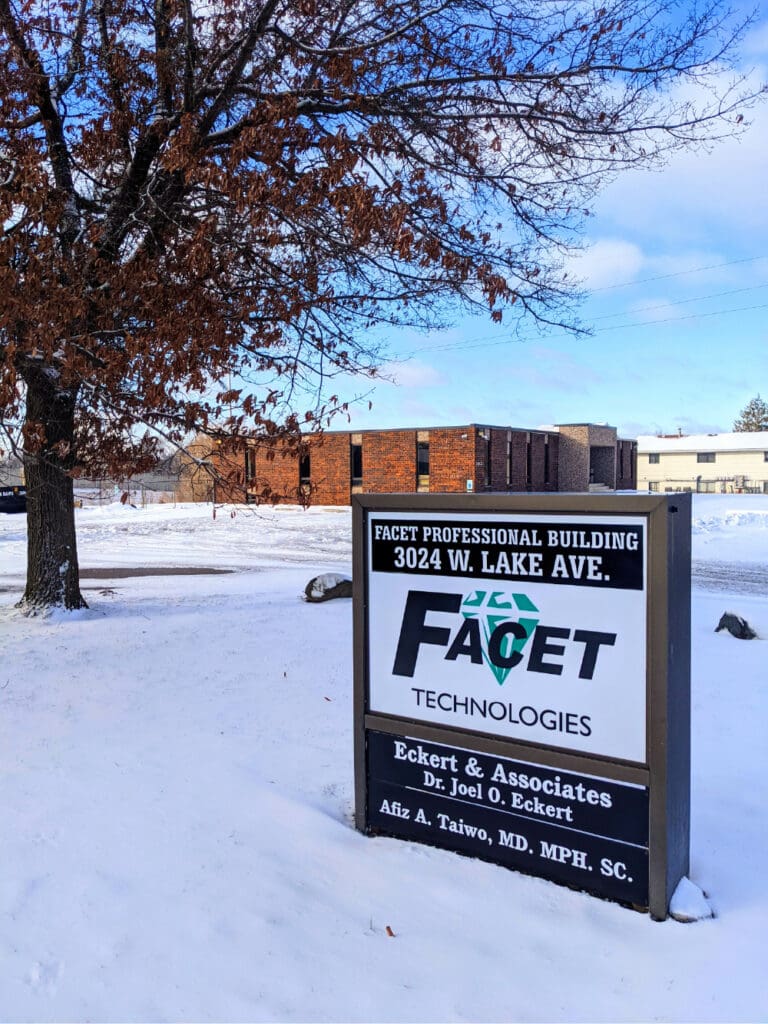
Facet’s new corporate headquarters as seen from I-74, just West of the Sterling Ave. exit.
We are excited to announce our new corporate headquarters, opening April 2021!
Thanks to all of our loyal customers, Facet has been growing and adding new team members, and it’s time that we needed more space to better serve you.
Our search for a new home for Facet was successful and we found a great building in the perfect location–centrally located so we can easily dispatch technicians to our clients, and spacious enough to allow us to work in collaboration comfortably.
Our new state-of-the-art headquarters will be located at 3024 W. Lake Ave. in Peoria, right off of the I-74 Sterling Ave. exit behind Westlake Shopping Center. It has a large parking lot and a ramp for easy access. Maggie and Boomer, our shop pups, are excited for the large fenced-in yard attached to the building complete with a picnic area for outside lunches when the weather gets warmer.
We are performing an extensive remodel of the building and will share indoor photos soon.
We have plans for a digital grand opening and ribbon cutting ceremony in April. We can’t wait to welcome all of our customers to see our new space once we can safely gather again.
Stay tuned for more updates during the move and transition to our new office!
This month’s tech tip is from IT Bench Technician Vincent Bethel. Vince shares how to clean your computer equipment to help keep you and others safe, especially on shared equipment.
We often talk about how to keep your computer “clean” and safe from digital viruses, but we don’t often talk about physically cleaning your computers and other equipment. It is an equally important task. Even before COVID, keeping your PC clean helped protect it from dust buildup and other issues that can cause the machine to overheat or components to fail. If you would like to learn how to sanitize a computer properly without damaging sensitive and delicate components, read on!
With COVID still around it’s important to know how to properly sanitize your computer equipment. Follow these steps to insure your equipment is properly disinfected:
1. Power off equipment and disconnect power cords and peripherals 2. Spray disinfectant on cloth or paper towel, don’t spray directly on the computer 3. Carefully and gently wipe in a uniform manner. For screens, wipe in one direction with overlapping strokes from top to bottom. 4. Wait a few minutes for the computer to dry. 5. Wash your hands.
Need to clean your keyboard, mouse or other accessories? Follow the same instructions above. If you need to get into nooks and crannies of your keyboard, dampen a cotton swab with a little isopropyl (rubbing) alcohol and use that to clean in the cracks. Be sure that your accessories are unplugged and powered off before cleaning, though! Not only is it an important step for making sure they remain in good working order, this step also prevents you from opening all sorts of random things on your PC during cleaning!
Need a virus cleanup or other more intensive “cleaning” for your PC or Mac? Call Facet today, or stop in one of our locations to find reliable, local help for tech problems.
Want more tech tips? Sign up for our monthly newsletter for information, great ideas, and even some fun!